Every Seat in the House: How Atlanta Theaters Are — and Aren't — Serving Moviegoers with Disabilities
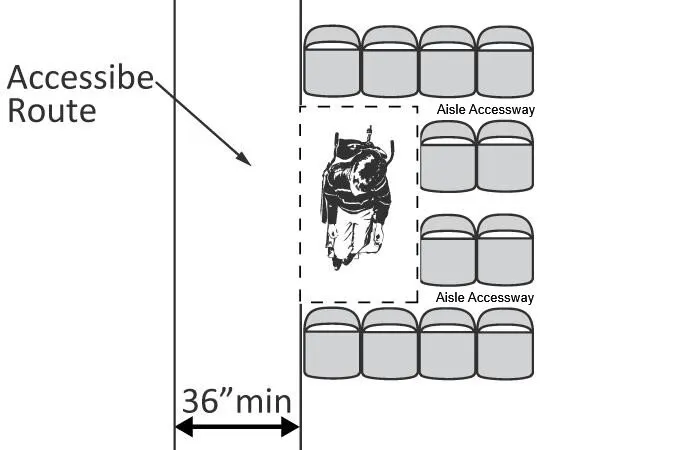
Photo: wheelchair accessible movie theater seating cinema accessibility, via images.squarespace-cdn.com
For most Atlanta moviegoers, buying a ticket and finding a seat is a pretty frictionless experience. For others, it's a process loaded with uncertainty — calling ahead to confirm equipment is working, arriving early to navigate unfamiliar layouts, or simply deciding it's not worth the risk of showing up and finding that the promised accommodations have fallen short again.
Disability access at movie theaters sits at an intersection of federal law, practical infrastructure, and something more human: the question of whether every person who wants to see a film on a big screen actually gets that opportunity. In Atlanta — a city with a wide range of cinema venues, from massive multiplexes to intimate indie houses — the answer is uneven.
What the Law Requires (and What That Means in Practice)
Under the Americans with Disabilities Act, movie theaters are required to provide a range of accommodations. These include wheelchair-accessible seating with companion seats, assistive listening devices, closed captioning devices, and audio description systems. The Department of Justice has also issued guidance requiring theaters to use digital cinema equipment to provide open captions and audio descriptions for patrons who need them.
But legal requirements and lived experience don't always match up.
"The law says the equipment has to be available," says Kevin Darnell, a Deaf Atlanta resident who has been attending movies at local theaters for over a decade. "It doesn't say it has to work every time. It doesn't say the staff has to know how to operate it. And it definitely doesn't say it has to be easy to ask for."
Darnell describes a pattern that will be familiar to many Deaf and hard-of-hearing moviegoers: arriving at the theater, requesting a closed captioning device, waiting while staff search for it, receiving a device with a dead battery or a broken mount, and ultimately watching the film without captions or not at all.
"It's happened to me at more than one theater in this city," he says. "And every time, I have to decide whether to make a scene or just let it go."
The Multiplex Experience
Atlanta's major multiplex chains — the large-format, high-volume theaters concentrated in areas like Buckhead, Sandy Springs, and along the I-285 corridor — generally have the infrastructure in place. Wheelchair-accessible seating exists, assistive listening devices are stocked, and most locations have the closed captioning receivers and audio description headsets required by law.
The challenge is consistency. Equipment maintenance, staff training, and the practical experience of requesting accommodations can vary significantly from location to location and visit to visit.
One theater manager at a major chain location in the northern suburbs, who spoke on background, acknowledged the gap. "We have the devices, we have the training materials, but staff turnover is constant and not every new hire gets a thorough walkthrough on the assistive tech," she said. "I've made it a priority at my location, but I can't speak for every theater in the chain."
Several disability advocates in Atlanta recommend calling ahead before any visit — not because it should be necessary, but because it reduces the chance of a frustrating experience.
Open Captions: A Growing but Incomplete Option
For Deaf and hard-of-hearing moviegoers, closed captioning devices — the small screens that attach to cup holders or seat backs and display dialogue — are the standard accommodation. But many in the community prefer open captions: captions burned directly into the projected film, visible to everyone in the auditorium.
Open caption screenings are increasingly available at Atlanta theaters, but they remain limited in frequency and timing. Typically scheduled at off-peak hours — early weekday mornings, late-night slots — they're often inconvenient for working adults or families.
"I appreciate that they exist," says Tanya Osei, a hard-of-hearing teacher in Marietta. "But they're usually at 10 a.m. on a Tuesday. I have a job. I want to see the movie opening weekend like everyone else."
Some Atlanta theaters have experimented with expanding open caption availability, and advocates are pushing for more prime-time slots. The argument is straightforward: open captions don't diminish the experience for hearing audiences in any meaningful way, and they dramatically expand access for those who need them.
Independent Theaters: Bigger Challenges, Genuine Effort
Atlanta's smaller, independent cinemas face a different set of challenges. Many operate in older buildings not originally designed with accessibility in mind, and retrofitting historic or vintage spaces can be expensive and architecturally complex.
"We've done a lot of work on physical access — ramps, accessible restrooms, designated seating areas," says the programming director of one well-regarded Atlanta indie theater, who asked not to be named. "The assistive tech side is harder. We're a small operation. We have the equipment but fewer staff to manage it, and when something breaks, it doesn't always get fixed immediately."
That honesty is appreciated by disability advocates, even as they push for better outcomes. What they describe as most damaging is not limitation but indifference — theaters that treat accessibility as a compliance checkbox rather than a genuine hospitality priority.
What Good Looks Like
Not every story here is a frustration. Several Atlanta moviegoers with disabilities describe theaters where the experience has been genuinely smooth — where staff are knowledgeable, equipment is maintained, and accommodations are offered proactively rather than reluctantly.
Audio description — a narration track that describes visual action for blind and low-vision patrons — is one area where some Atlanta locations have received particular praise. When it works, it works well: a headset tuned to a separate audio channel delivers clear, professionally recorded description that allows visually impaired audiences to follow the film fully.
"When it's working and the description is good, it's a full movie experience," says Raymond Chu, a low-vision Atlantan who attends films regularly. "I don't want a different experience. I want the same experience everyone else is having."
That framing — not special treatment, just equal access — is at the heart of what disability advocates are asking for.
The Path Forward
Advocates in Atlanta are calling for a few concrete improvements: more open caption screenings at accessible times, mandatory staff training on assistive technology at every location, and better communication on theater websites about what's available and when.
Some are also pushing for mystery shopper-style audits of accessibility compliance, arguing that self-reporting by theaters isn't sufficient to identify gaps.
"Atlanta is a city that takes its entertainment seriously," Darnell says. "We spend real money on our theaters, on our film culture. It shouldn't be too much to ask that everyone gets to be part of it."